What is the future direction of surface treatment technologies?
von Nick Coombes,
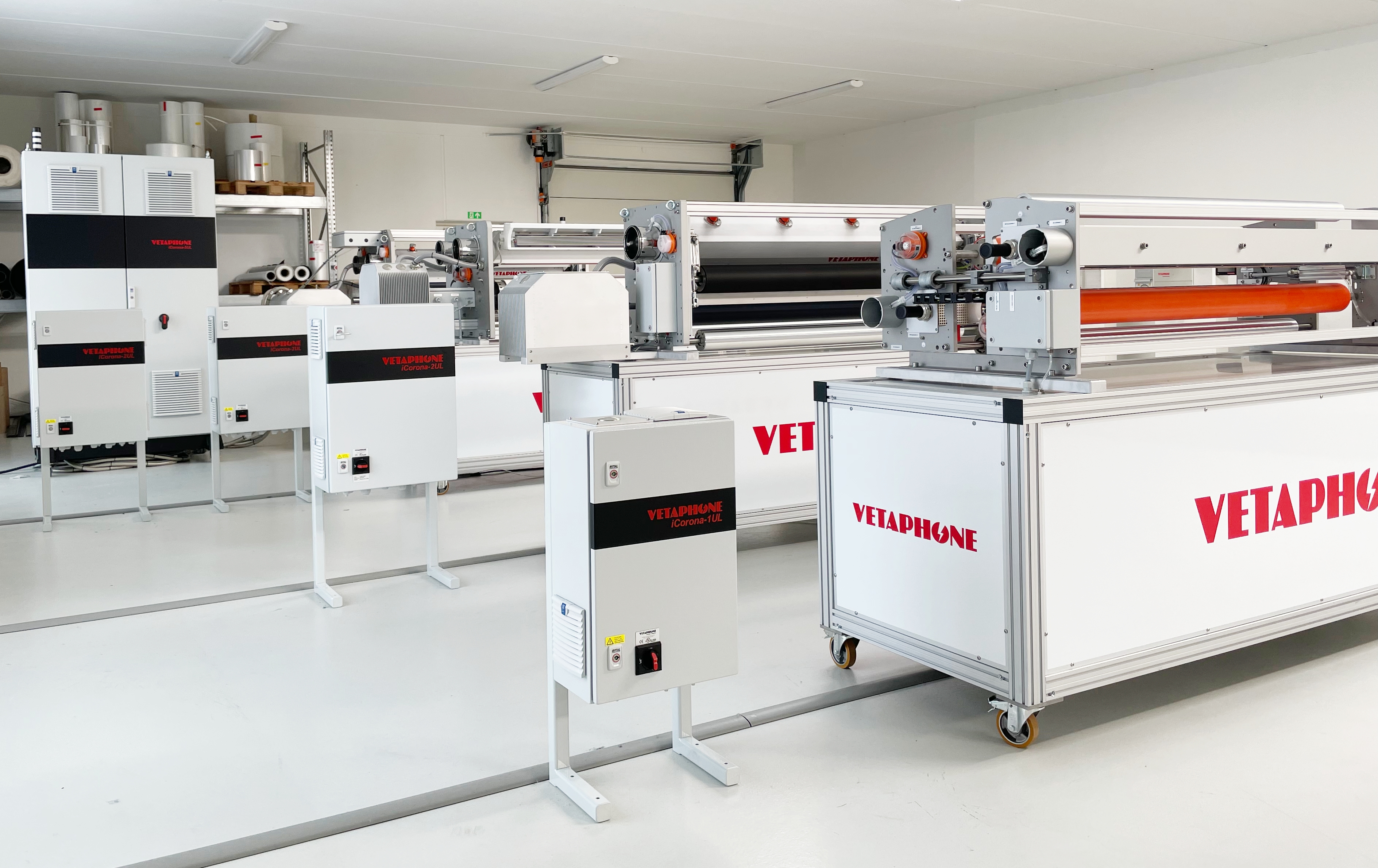
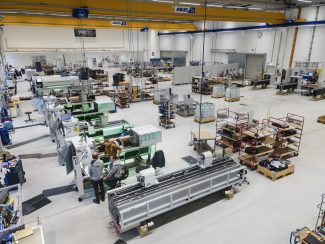
The showroom offers in-person and online demos of a comprehensive range of Vetaphone technology
(Source: Vetaphone)
With current trends in the package printing sector being driven by environmental considerations and burgeoning energy costs, has the time come to review and re-evaluate surface treatment methods? Kevin McKell, Chief Sales Officer at Danish manufacturer Vetaphone A/S looks at the background and considers various options.
We live in a changing world, of that there can be dispute – and some of these changes are having a major impact on the way we live our lives and earn a living. Some, seemingly, are beyond our control, but others are not and it’s these I’m calling into question because there are steps we can take to mitigate the situation, if not turn it around.
Anzeige
Kevin McKell is Chief Sales Officer (CSO) at Vetaphone A/S (Source: Vetaphone)
Those of us involved in the package print sector are aware of the need for improved sustainability in our processes and greater environmental protection from our products. But all this comes at a time when demand continues to rise, and production costs are under constant scrutiny from brand owners and consumers alike.
One area that often overlooked, but offers a real-world solution is surface treatment, or rather the process chosen to perform it, and my conjecture is that by reviewing and refining their current activities, converters can make a significant reduction in energy costs and at the same time reduce their carbon footprint for the benefit of the environment. If your process needs surface treatment – read on!
Why is surface treatment needed?
Simply, because liquids such as ink or varnish will not adhere securely to non-absorbent materials if there is a mismatch of surface energy between the two. This was first discovered in the printed packaging sector back when plastic substrates were becoming popular – think supermarket carrier bags in the 1950s. Early production encountered problems with ink adherence on rolls of supposedly identical material supplied by the same manufacturer. What became apparent was a need to raise the surface energy of the material to match that of the liquid to allow a process known as ‘wetting out’. This surface energy is measured in Dynes, and the level can decay over time, owing to factors that largely relate to storage and transportation of the material rolls.
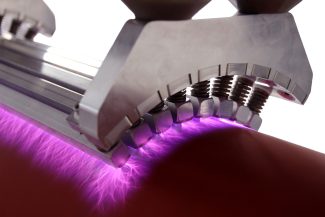
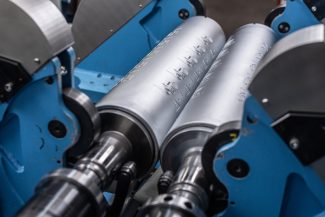
The corona process is a high-powered electric discharge fired at a 1.5mm distance from the substrate (Source: Vetaphone)
So, surface treatment in the packaging industry is a fundamental – no argument! The need to modify the surface structure of certain substrates to allow them to be converted into packaging items, especially in the food sector where extended shelf-life helps reduce waste, is an accepted part of what is one of the largest global industries, and one that is projected to continue an upward trend for the foreseeable future. But it’s a constantly changing scene, with new substrates (especially filmic), and new requirements (international legislation) keeping surface treatment technology at the forefront of manufacturers’ and converters’ minds – the goal posts keep moving!
If we look at the present situation and how the demand for surface treatment has influenced the development of technology we find that flame treatment is most often used for large surface areas treated at very high speed. The flame, at a temperature between 1000 – 3000° Celsius is brought into close proximity to the material allowing it to remove contaminates and burn-off fibres. The negative points are its effect on delicate materials, the safety hazard it poses for personnel, and its energy consumption.
On the electronic side there are two options. Corona treatment is more economical than flame and has a more diverse range of applications. It is best suited to high-speed printing presses and laminating lines, blown film and extrusion coating applications. It is also easy and inexpensive to integrate with the production line. In addition to corona is plasma treatment. Not to be considered as ‘corona mark 2’, plasma nevertheless is based on an electronic discharge, but where corona treatment takes place in ambient air, plasma requires a closed and controlled environment into which measured dosages of dopant gases are added to affect the process. Its complexity makes it a far more expensive option than corona, but its sophistication is useful if not essential for specific applications and substrates.
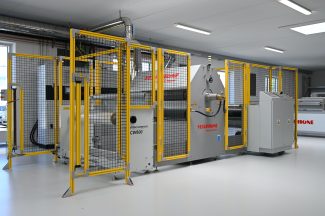
The company’s unique Test Lab in Denmark offers opportunities for manufacturers, converters and brand owners to test new products before market launch (Source: Vetaphone)
One of the clear trends in today’s packaging production sector sees converters replacing traditional flame treatment with corona treatment on a variety of substrates, especially in the paper and board markets that have always needed the deeper and more sustained treatment effect of flame. While historically flame has been the preferred surface treatment, the current shift in thinking has been brought about by a variety of factors, not least of which is the rapidly increasing cost of gas across developed markets. So, what’s changed? In short, the quality of the paper and boards needing treatment and the capability of the latest corona technology. Modern manufacturing methods have significantly reduced the fibre and surface contamination from dust and oil in the production environment. This makes corona treatment a more than viable alternative, notwithstanding its energy cost-savings that are already being enjoyed by a growing number of converters.
But other factors are adding weight to the argument for change. Corona surface treatment has also been around for many years – in fact it was invented by Vetaphone back in the early 1950s, and the Danish company has pioneered its development in subsequent decades. Where flame has always been thought of as the shotgun approach for rough and rugged surface treatment, corona was always perceived as a more finely targeted approach for more sensitive material. The result of both flame and corona treatment is the same in that the surface of the substrate is modified to allow better adhesion of liquids such as inks, varnishes, and adhesives.
It’s both a cost and a conscience issue
So, if the two methods achieve the same, what’s the problem? The issue is that flame treatment comes at a price, and one that is not measured solely in monetary terms. In the case of many suppliers to the industry that price is carbon emissions and all that these imply in terms of the environment in which we live. It’s not a new issue but with obvious climate changes being seen worldwide, it is becoming a more prominent problem that needs addressing, and soon.
First of all, it’s important to understand exactly what are the terms of reference for carbon emissions. Current CO2 emissions average 6.6 tonnes per capita globally, or more than twice the levels of pre-industrial times, and in developed countries it can be up to 10 times as high. Carbon dioxide (CO2) is the main culprit in what are generally known as Greenhouse Gas (GHG) emissions, and are created by burning fossil fuels like coal, oil, and gas.
Heat, industry, and transport are the major emitters, accounting for around 60% of the total. GHG emissions are responsible for global warming as they prevent heat from escaping into the atmosphere. Basically, the Sun emits short wave radiation (sunlight) that passes through the greenhouse gases to heat the Earth’s surface but in return the long wave radiation is trapped and prevents the heat from dissipating.
Plan for a better environment
How can we achieve this? In simple terms, stop burning fossil fuels. In practical terms, start reducing the levels of CO2 emitted and create a financial incentive to make it happen. Essentially, this is what carbon trading is all about and since the use of flame surface treatment in packaging production is a major contributor to GHG emissions, a switch to a ‘cleaner’ technology, like corona, can offer significant financial benefits – both from lower energy consumption at a time when costs are rising, and the ability to offset reduced carbon emissions by selling them to higher emitters.
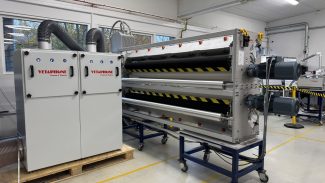
Vetaphone says its 21st century corona technology is the cheaper and greener alternative to flame surface treatment (Source: Vetaphone)
Carbon emission trading seeks to put a cash value on the volume of carbon emitted by countries thereby allowing them to meet their pledges under The Paris Agreement of 2016. As of 2023 there are 194 states, and the EU as one body, that have signed the Agreement, representing around 98% of total GHG emissions.
Emissions trading sets a quantitative total limit on the emissions produced by all participating parties, which correspondingly determines the prices of emissions. Under emission trading, a polluter having more emissions than its quota must purchase the right to emit more from emitters with fewer emissions. This is seen as more effective than a fixed carbon tax because it allows greater flexibility. Each country defines its own emission trade allowance, and this varies from a low of around $7/tonne in Asia to around $63/tonne in the EU.
Programmes such as the European Union Emissions Trading System (EU-ETS) complement the country-to-country trading stipulated in the Kyoto Protocol by allowing private trading of permits, coordinating with national emissions targets provided under the Protocol. Under such programmes, a national or international authority allocates permits to individual companies based on established criteria, with a view to meeting targets at the lowest overall economic cost.
No time to waste!
With most brand owners and a growing number of consumers now very aware of the term ‘carbon footprint’ and what it means to the well-being of the planet and future generations, there is no time to lose. And this is where the situation also becomes of financial benefit to those switching to lower carbon emitting practices, such as using corona rather than flame surface treatment for the production of packaging. By reducing the gas consumption needed for flame treatment and consequently reducing the energy cost, while at the same time emitting less carbon into the atmosphere that allows you to trade your lower emission rating to a higher emitter, and banking the benefit in cash, production costs can be significantly reduced – and your environmental conscience salved!
Corona treatment is a patented, well-proven and globally accepted standard in the production of packaging using non-absorbent substrates. As a mature process of more than 70 years its efficiency and cost-effectiveness are well documented, and ongoing research ensures that it continues to maximise bonding strength on each of the new substrates that are continually being developed. Whatever your surface treatment needs, Vetaphone, as the inventor of corona technology, has unrivalled knowledge and expertise to resolve your problems.
Author
Nick Coombes is a veteran print publicist having joined the industry in 1977. He has worked as an independent marketing specialist to many of the leading machinery manufacturers over the past five decades, most recently in the package print sector. He is also an editorial consultant to many of the leading international print media owners.