Polyurethane Printing Inks Are Transforming the Gravure Industry
von Ansgar Wessendorf,
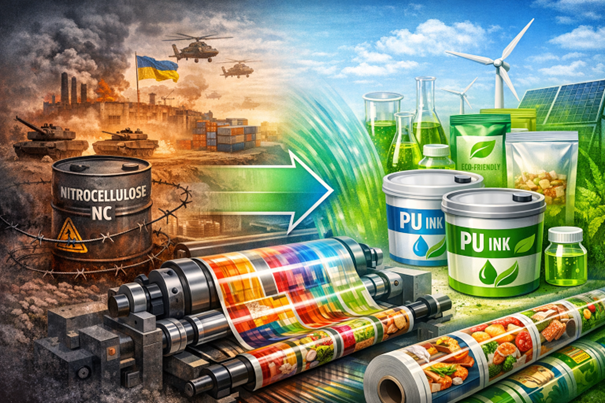
The illustration depicts the transition in the gravure printing industry from nitrocellulose (NC) inks to environmentally friendly polyurethane (PU) inks. While the left side symbolizes the geopolitical and logistical challenges of NC, the right side highlights the sustainable, efficient, and high-performance future with PU inks
The gravure printing industry is at a critical turning point. For decades, nitrocellulose (NC) dominated as a reliable binder in the production of printing inks. However, geopolitical tensions, raw material shortages, and stricter regulatory requirements are forcing the industry to seek sustainable and technologically advanced alternatives. At the heart of this transformation are polyurethane (PU)-based printing inks, which are proving to be both environmentally advantageous and highly effective.
The Nitrocellulose Crisis
Nitrocellulose has long been an indispensable component of printing inks and is also a critical raw material for military applications. Increased military demand, driven by conflicts such as the war in Ukraine, has put global supplies under significant pressure. Production capacities are concentrated in a few countries—primarily China—making supply chains extremely vulnerable to political and logistical disruptions.
Anzeige
Strikes, port closures, and extreme weather events further exacerbate the situation. Many manufacturers now prioritize military-grade NC or have entirely shifted away from commercial production. For the gravure industry, this means that alternative printing inks must be both readily available and resilient against supply chain risks.
PU Printing Inks: Sustainable, Powerful, and Efficient
In response to the challenges facing NC-based inks, the gravure industry is increasingly turning to PU-based systems. PU inks have become well-established in Asia—including China, Japan, India, and Bangladesh—offering outstanding heat resistance, chemical stability, and sterilization performance. This makes them ideal for PET-based laminate films requiring oxygen barriers and mechanical durability.
PU inks also perform exceptionally well in high-speed printing, allow lower ink deposition, and reduce solvent consumption. Modern PU systems are cost-effective, comply with all major global food safety standards, and offer a practical alternative to PVC- and NC-based inks.
Case Study: Flexglide by UFlex Chemicals
A pioneer in this development is UFlex Chemicals with its Flexglide series. Variants such as Flexglide NT (toluene-free) and NTNK (toluene- and ketone-free) deliver excellent results on substrates including PET, BOPP, and nylon. The products are characterized by low viscosity, reduced solvent usage, and minimal odor, extending the lifespan of gravure cylinders and doctor blades.
Flexglide NTNK 6S is a pure polyurethane system that ensures high adhesion and stability during sterilization and pasteurization processes, making it suitable for a wide range of laminate applications.
Efficiency and Sustainability
Flexglide printing inks demonstrate how performance, efficiency, and environmental responsibility can be combined. High color intensity at lower ink coverage enables up to 20% reduced solvent consumption, lowering costs and minimizing environmental impact. All products are certified according to leading global standards and are suitable for food packaging applications.
The shift from NC to PU-based inks is not merely a response to supply chain pressures; it also reflects the industry’s growing commitment to sustainability, safety, and regulatory compliance.
Conclusion
The gravure printing industry is undergoing a dynamic transformation. As nitrocellulose becomes increasingly scarce, PU printing inks open new pathways to greater efficiency, sustainable production, and regulatory security. Companies that adopt these technologies early not only gain long-term competitive advantages but also contribute to a more resilient and future-ready printing industry.